By Joe Miele, President of C.A.S.H.
 As we know, hunters talk a good game about preventing overpopulation, halting the spread of disease, and putting “organic meat” on the table. Some will go as far as to say that hunting is not just what they do but it’s who they are, and nearly all hunters will say that their objective is not to kill an animal to put “its” head on the wall of the living room, but that their activity as a hunter makes them a vital part of the ecosystem. They have deluded themselves into believing that they have taken the place of a deer’s natural predators whom they extirpated long ago.
Some hunters satisfy their blood lust by killing animals confined to a fenced-in area in a canned hunt, but this type of hunting is not universally accepted by the hunting fraternity. The “old guard,” and those who learned from them, tend to see canned hunting as an affront to “real” hunting where the animal is at least given a scintilla of a chance to get away. So what are hunters to do when they want to kill animals with impressive antlers but they don’t want to look like slobs?
“Back in the day” when there were only Native Americans in what is now the continental United States, the number of whitetail deer was about 20 million. Unrestricted hunting for hides, meat, and pest control reduced that number to about 500,000 by the late 1800’s, and at that time restrictions began to be put into place to prevent hunters from pushing native deer into extinction. Today the population has returned to about 20 million, thanks to the intentional manipulation of deer herds by hunting agencies as a way to provide hunters with animals to kill.
Even with 20 million deer to kill, hunters complain about the lack of trophy bucks and, shockingly, sometimes about the lack of any deer at all to hunt. Interestingly, they may be right about trophy bucks as the typical state-sponsored hunting program results in 80-95% of all male deer killed when they are about 1½ years old.

ENTER “QUALITY DEER MANAGEMENT” – OR QDM FOR SHORT.
What is it?
QDM is a program that uses hunting restrictions, intentional feeding, and habitat manipulation to increase the size, age, and antler spread of deer in the area being managed. Through manipulating the density and sex ratio of deer in a given area, and by modifying habitat through planting flora favorable to deer, and by distributing supplements, QDM practitioners can create an environment where they can produce larger and stronger bucks with “trophy” antler spreads.
In order to build a successful QDM enterprise (one that builds a population of “trophy” deer that the owner can turn into cash by charging hunters large fees, sometimes in the thousands of dollars, for the privilege of killing them), several principles must be implemented:
- Restrict the number of deer killed by age and sex;
- Manipulate habitat by establishing food plots and forage areas that contain 12 to 18 percent protein and abundant levels of calcium, phosphorous, and other important nutrients;
- Manage hunters to keep the Neanderthals from shooting everything that moves;
- Collect data and keep records charting the progress
For QDM to work, hunters must stop salivating and resist the urge to kill younger bucks in order to allow them to survive to maturity when they will then exhibit the traits they seek. While spokespersons for QDM claim the goals of the program are not about putting a “monster buck” behind every tree, we find it hard to see any other objective after researching the program, its implementation, and its results.
To successfully run a QDM enterprise, whether private or government via the state wildlife management agencies, land owners (state owned or private) need to manipulate the age, nutrition, and genetics of the animals present on the property.
A buck will typically grow his first set of antlers at 1½ years of age. By age 5½ they have reached their peak weight, and by 6½ years old they have achieved their maximum antler size. Under the provisions of typical hunting programs set up by state wildlife agencies, it is rare that deer will survive to maturity. QDM proponents change the rules of the hunt and allow young bucks to live. This is difficult for most hunters with the “I’m gonna kill every buck I see ‘cuz if I don’t kill ‘em someone else will” attitude and, as you’ll read later, many hunters are fed up with QDM despite the fact that QDM gives them exactly what they want. Hey, we never said hunters were very bright.
Since QDM hunters want animals with impressive antlers, they pay attention to the nutrition needed to allow deer to grow to their full potential.
Typical hunting seasons and programs may satisfy the greater number of hunters who are looking to kill anything at all, but for the trophy seeker these types of hunting seasons are less than adequate.
QDM lowers the ratio of does to bucks and increases the likelihood that deer are impregnated early in the breeding season. These deer will give birth earlier in the year and their fawns are more likely to survive and thrive, though the population will not grow as quickly as a traditionally hunted population will (QDM is not concerned with sheer numbers).
QDM is a program that takes years to implement, and creating an environment where deer are allowed to mature and grow to their maximum potential often takes the cooperation of several landowners if it is to work, since pretty much everything the state does makes such management objectives impossible.
Feeding Plots
 Property managers must agree to certain key elements of QDM habitat manipulation since developing larger, older, and healthier deer is dependent upon the availability of higher quality food and having adequate cover for the animals. Deer feel safe in thick-cover but they eat at food plots or edge habitat.
Experts at QDMA recommend food plots to be primarily made up of perennial clover. Clover will provide a protein level exceeding 20% and deer find it irresistible. Plants in the brassica family (cabbage, cauliflower, broccoli, Brussels sprouts and mustards) are great for deer as their starches turn to sugar after a few frosts, while wheat and rye is also highly attractive to deer these plants give deer plenty of calories for optimal growth. Minerals are as important as protein for optimal antler growth, so many hunters involved in QDM will leave mineralized pellets out for deer during the summer. Fruit trees are also favored by deer, and many QDM managers will plant pear trees, since they will yield generous amounts of fruit. Crabapple trees are also a favorite for deer.
Hunting and “Culling”
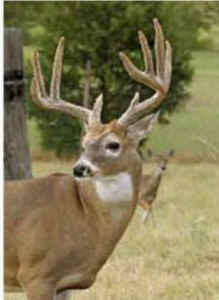 Of course, hunting must take place every season because what good is QDM without the fun of blowing away an animal who wants to live? Even before a QDM program starts showing results, hunters continue to express their violent desires by killing animals. They do, however, limit the killing of bucks with good starting antler points and spreads, and those who show the potential for larger than typical body growth by making deer with eight points or less (four points to a side) off limits to hunters. Eighty percent of bucks under two years of age and 25% of those between two and three years of age will be protected. Likewise, restricting the killing of males with antler spreads of 15” or less can protect about 95 percent of yearlings and up to 40 percent of 2½ year olds for future killing.
But QDM is not only about male deer and antlers as killing females is the prime factor that affects deer density, sex ratio, and habitat quality of a given area. Both typical game managers and QDM game managers know that killing equal numbers of bucks and does can maintain a deer population, killing more does than bucks decreases the population, and killing more bucks than does increases the population.
QDM managers seek to kill the “correct” number of does to achieve their goals.
QDM practitioners will put age restrictions on the animals they kill, and knowing the physical characteristics of deer bodies at different ages can aid in a fairly good estimate of how old a deer is. There are many ways to do this, from the muscle structure and facial characteristics to the general size and shape of the animal.
QDM hunters must know the age of the animals they are killing if QDM is to be successful and if they are to bring home the best trophies with all the bragging rights that go with them.
QDM takes years to implement and it is part science, part sport. Its objectives are needlessly violent and like all forms of recreational hunting it is a form of animal exploitation, torture, abuse that extends to the additionally victimized public.
After all this, you would think that hunters would be happy with QDM and with the opportunity to kill larger deer with “trophy” antlers, right? Guess again. Many hunters are fed up with QDM as they feel it puts too many restrictions on their hunting trips. They are forced to pass on deer they would love to kill because they happen to be too young or because their antlers are not developed enough.
Some property owners balk at the prospect of purchasing QDM insurance, something the Quality Deer Management Association (a group that promotes QDM philosophy and implementation) offers as an option to its dues paying members. Property owners are encouraged to obtain $1,000,000 in liability insurance (ironic, considering how often they try to convince us that hunting is a safe sport) and $100,000 in fire insurance. Hunters love to start fires to keep warm–not too smart in a forest.
Some hunters criticize QDM because it has no affect on the transmission of epizootic hemorrhagic disease (EHD), a disease common to deer that is caused by a virus passed along by the biting midge (a small fly).
 This is curious, as traditional hunting methods do not address the spread of EHD either. Other hunters become impatient with having to wait several years before seeing the antler results they want. It seems that you can’t please all killers.
Quality Deer Management is another way to manipulate deer for the benefit of hunters. It has a few objectives which are to provide trophy hunting opportunities and a source of income for property managers, and its implementation requires the killing of young fawns and immature does. A successful program will strengthen the sport of hunting more than it helps the deer. Hunters will say that QDM is one way that wildlife benefits from their activity, but as we’ve seen countless times before, it is little more than another way for hunters to secure bragging rights. Quality Deer Management is another form of animal abuse and the misappropriation of funds, the betrayal of public trust, and the waste of wildlife that belongs to all. It causes the delay of management for wildlife watching which would bring in far more revenue and benefit the general public.
Sources:
- Quality Deer Management Association
- WhiteTailsInSight.com
- OutdoorChannel.com
- Quality Deer Management: The Basics and Beyond by Charles J. Alsheimer
- Pennsylvania Game Commission
- University of Missouri Extension
- PetersonsHunting.com
- BigGameLogic.com