By Chuck Augello
“It’s hand-to-hand combat up
there!”
Hey, I don’t mind arm wrestling with the dudes,
but those wackos use guns and bows and arrows!
The speaker, Dennis Ohab, stood at the podium nearly shaking with fear.
Identified by The New York Times as a turkey hunter from Jefferson Township, New
Jersey, Ohab had come to urge the New Jersey Fish and Game Council to initiate a hunting
season on black bears. On June 6 of this year, nearly five hundred people packed the
National Guard Armory in Lawrenceville to debate the need to reduce the state’s bear
population.
According to the state, over one thousand bears call New Jersey home. Opponents of the
hunt consider this a deliberate overstatement, and even the state’s own Black Bear
Management Plan (1997) contradicts the figures.
However, at the time of the hearing the Council had already made its opinion known.
The 2000-2001 Game Code included an amendment calling for a hunting season on black
bears with the goal of killing up to three hundred and fifty bears during the first year.
Since, by law, the Council is required to hold a public hearing regarding changes
to the Game Code, it was now the public’s chance to speak out on the issue.
As the nasal-voiced Ohab recounted his story of being “chased” by a bear,
many in the audience began laughing. Ohab, in a state of near hysteria, pleaded with
the Council to do something. “Sooner or later our children will get
killed,” he said.
While Ohab’s agitated account of “hand to hand combat” between people and
bears was an almost comical exaggeration, his fears echoed those of many at the hearing.
Several participants spoke of being afraid of possible bear attacks, and John W.
Broadway, the chairman of the Council, cited “safety” as the primary reason for
the hunt.
On the other side, opponents of the hunt spoke of peaceful backyard encounters with
bears and often described the bruins as “gentle.” With few exceptions, the
perceived threat posed by bears dictated one’s feelings about the hunt. Those who
saw bears as dangerous supported the hunt; those who viewed bears as non-threatening
opposed the hunt.
So the question begs asking: How much of a threat are black
bears to the safety of New Jersey residents?
If one looks at the data objectively, the answer is: not much of a
threat at all.
In both the 1997 New Jersey Black Bear Management Plan and the 2000 Black Bear status
report, the Division of Fish and Wildlife could cite only two examples of a black bear
inflicting injury on a human. In 1986 a woman received three minor scratches when
she encountered a bear in the dark. In 1996 an individual was bitten on the finger
when he extended his hand toward a bear. Neither individual received medical attention.
There are no other reported cases of a bear injuring a human in New Jersey. While
this fact seems crucial to any honest debate about the threat posed by bears, it is rarely
cited in newspaper reports and press releases from the DFW.
The 1997 report further states that of the thirty-seven known deaths caused by black
bears in North America since 1907, nearly all were associated with three geographic areas:
Alaska, Alberta/British Columbia, and Ontario/Michigan. According to the
report, “…the black bears involved in fatal attacks on human beings lived in less
developed/remote areas and apparently had little or no prior contact with humans.”
New Jersey, the most densely populated state in North America, clearly does not fit
this profile. The state’s bear population, out of necessity, has grown accustomed to
the presence of humans.
If further evidence is needed, one can look to a study by John O’Pezio, a black bear
specialist with the New York Department of Environmental Conservation. During the
period 1960 through 1980, O’Pezio tallied a minimum of 77
million recreation days spent by people in areas occupied by New York’s black bears.
Only three bear-related injuries occurred, all of which were minor.
In “The Great American Bear,” author Jeff Fair offers further evidence on the
potential threat. For each death caused by black bears, approximately seventeen
people in North America have died of spider bites, twenty-five by snakebites, and
sixty-seven due to attacks by domestic dogs. According to Fair, “…on the
whole you are statistically 374 times more likely to be killed by a bolt of lightning than
by a black bear.”
If that isn’t enough, consider this: Humans attack and kill their fellow humans
at a rate of over 90,000 times that of black bear manslaughter. So which species is
the greater threat?
Unfortunately, the Fish and Game Council has not publicized these facts. In order
to maintain and expand its budget, the DFW must sell as many hunting licenses as possible.
A hunting season on bears represents a new revenue stream for the Division. More
significant is the personal bias of the Division’s members. In essence, the people
who make the rules about hunting are people who like to hunt. The Fish and Game Council
and its cronies from various “sportsmen” organizations support the hunt because
they like the idea of killing bears. The perception of bears as being a threat to
public safety advances the Council’s goal and so little is done to publicize the truth.
Sadly, the mainstream media has followed the Council’s lead. It seems like a
no-brainer: if a major theme of a news story is the danger posed by bears, shouldn’t
the reporter investigate the extent of the threat? Apparently not. Even the
venerable New York Times failed to cite any statistics regarding violent encounters
between bears and humans. Two of the state’s largest newspapers, The Star-Ledger and
The Trenton Times, quoted opponents of the hunt but omitted any facts that might have
supported the anti-hunting position.
As expected, the Fish and Game Council approved the hunting season on bears, and
starting this fall bears will once again be legally killed in the Garden State.*
While grass-roots organizations like the New Jersey Animal Rights Alliance (NJARA) have
done an admirable job of countering the negative press, these small organizations lack the
resources of the DFW and can do only so much. Opponents of the hunt must use every
opportunity to educate the public regarding the almost non-existent threat of a black bear
attack.
It won’t be easy. As noted bear expert Dr. Lynn Rogers has stated, “It’s
tough to convince people that what they believe is a vicious animal really isn’t.”
Yea! After much public pressure
and many thanks to NJARA, Stu Chaifetz, HSUS, and many others who called to save the
bears, Gov. Christie Whitman requested that the game commission call off the bear hunt and
they granted her request!
[The game commission consists of some governor appointees.]
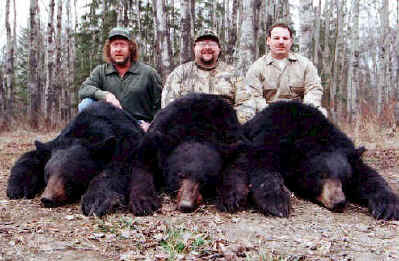
Black Paw Outfitting Co., Alberta, CA bemoaned the
following: “The only negative in the spring of 2000 season was the high number of
lost bears at 11. Please practice with your weapon of choice, so that we do not have this
occur again.”Photo from: http://www.bearpaw.ab.ca/bear_s00.htm