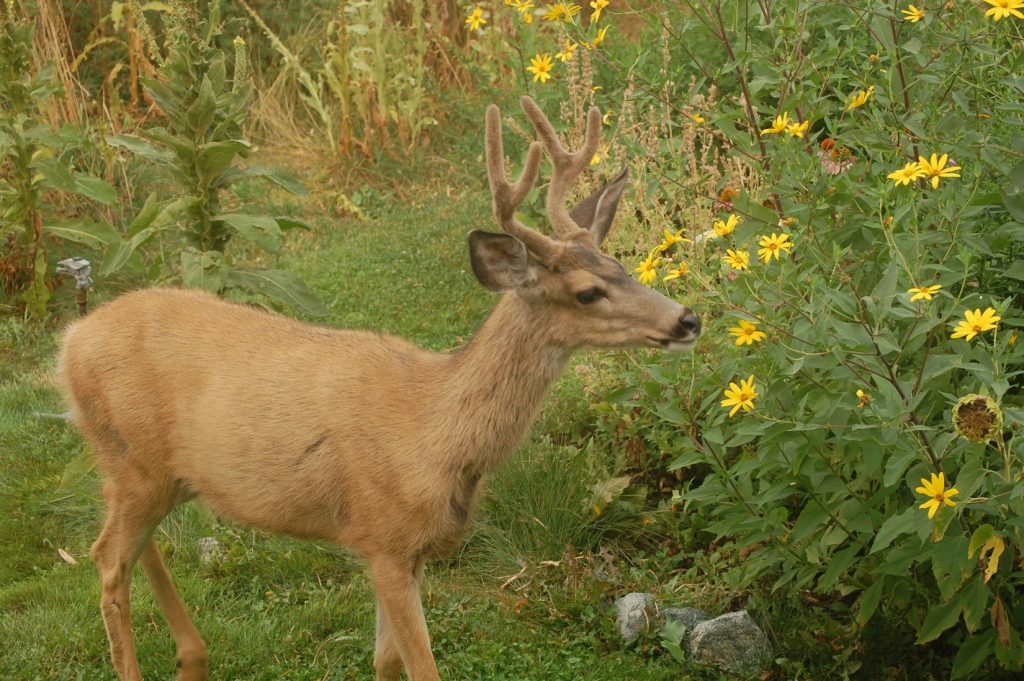
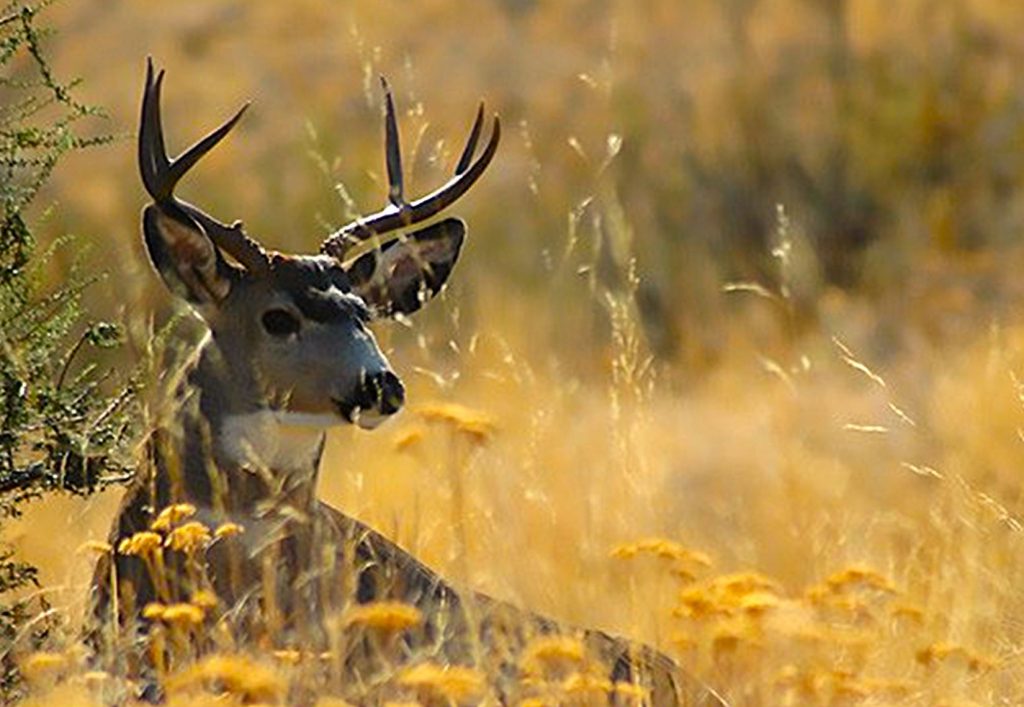
[/vc_column_text][vc_column_text]The days are growing shorter, the nights cooler and you’ve long since polished the previous summer’s velvet off your antlers. You’re feeling primed and ready for the coming breeding season. But you’re torn between the urge to seek out others of your kind and the nagging awareness that you shouldn’t let yourself be seen by the strange upright beasts who sometimes turn foul, aggressive and murderous this time of year.
Your mate and the rest of the does, whose company you yearn for, don’t have quite as much to fear as you and the other bucks. At first sight of your proud antlers, the horrible 2-leggers will zero-in and follow you like bloodthirsty mosquitos…
Cautiously proceeding deeper into the forest, you lose track of the pursuer and hope he’s gone away.
All at once you feel the searing pain of something tearing into your side and a loud crack like thunder pierces the silence. You fall to the ground gasping for air. Someone is approaching, but you can’t get up—the pain is all-consuming. He is standing over you now, pressing something sharp against your throat…
Everything is going black as you think back on Autumns past and envision your mate and the young ones…and you fear for their safety.
Clearly, from the deer’s perspective, sport hunting is not an ethical pastime.
Since the dark ages of Descartes, certain people have tried to keep non-human animals down and justify their exploitation with the absurd and arrogant allegation that animals don’t really care what happens to them because they aren’t capable of feeling, choosing, or perceiving—they aren’t “conscious”.
Say what? What are they, unconscious?
To borrow a redneck phrase, I promise I’ll never resort to again, ‘that dog don’t hunt!’
Regardless of the mindless carnage and the annual body count, even the mainstream media goes out of their way to help perpetuate the myth of the “ethical hunter.” But you’re more likely to see a unicorn in a UFO land in the middle of a crop circle than to meet a hunter who is truly ethical to the animals he kills. How can tracking down an inoffensive creature and blasting it out of existence ever really be ethical anyway? No matter how a hunter may rationalize, or claim to give thanks to the animal’s spirit, the dying will never see their killer’s acts as the least bit honorable.
I’m sure Ted Nugent considers himself an ethical hunter. Heck, Ted Bundy probably thought himself an ethical serial killer. But to their victims they’re just murderous slobs. Likewise, Teddy Roosevelt—who, in his two-volume African Game Trails, lovingly muses over shooting elephants, hippos, buffaloes, lions, cheetahs, leopards, giraffes, zebras, hartebeest, impalas, pigs, the not-so-formidable 30-pound steenbok and even a mother ostrich on her nest—considered himself an exceedingly ethical hunter.
All hunters, whether they call their hobby an act of sport or subsistence, eat what they kill (or at least give the meat away to others). Would Jeffrey Dahmer be considered ethical just because he ate those he murdered? Though some get more pleasure out of the dirty deed of killing than others, no hunter would even be out there doing it if they didn’t get some joy out of the act of stalking and “bagging” their prey. But there are less destructive ways to get your kicks and healthier, less costly sources of nourishment than cholesterol-laden, carcinogenic rotting flesh.
Although they may not take trophies or photographs of themselves with their kill, nearly everyone who hunts gets some kind of a thrill when boasting about their conquest or sharing the spoils at the neighborhood barbeque.
Words like “heritage” and “tradition” are only as good as the deeds they sanctify. That’s why there’s no Slave-trader’s Heritage Act or Indian-massacrer’s Heritage Act—society has rightfully deemed those behaviors obsolete, at best. Yet, the Safari Club, the NRA and other pro-kill groups have been pushing the U.S. Senate to approve measures and amendments, such as the “Sportsmen’s” Heritage Act of 2012.
This year, the state of Florida joined the ranks of those wanting to enshrine the right to kill recreationally. Their amendment 2 seeks to preserve forever ‘the “right” to hunt and fish, “…including by the use of traditional methods, as a public right and preferred means of responsibly managing and controlling fish and wildlife.”
But as Charles O’Neal, chairman of the opposition group NoTo2.Org points out, “customs and tradition are fine until one’s undertakings result in the suffering or repression of others.”
When a “sportsman” tells a non-hunter, “I’m okay with you choosing not to hunt, so you should accept my choice to hunt,” it’s like an unrepentant slave owner asking an abolitionist to accept his right to keep people enslaved.
Some activities just aren’t worthy of being passed on to future generations. To enshrine hunting—the serial murder of wildlife that has led to decimation and extinction for so many—with a disgraceful act of Congress does not represent a step forward for humanity.
The following quote from Richard Wrangham and Dale Peterson’s book, Demonic Males: Apes and the Origins of Human Violence, is tailor-made for the likes of the Sportsmen’s Heritage Act: “To find a better world we must look not at a romanticized and dishonest dream forever receding into the primitive past, but to a future that rests on a proper understanding of ourselves.”
An enactment of Congress should always denote a societal advancement, rather than a stumbling step backwards.
Without a doubt, our species, Homo sapiens, has made some staggering achievements over the ages. No other animal has ever harnessed fire, split the atom, invented a religion or come up with a way to leave Earth’s atmosphere, travel through the void of space and land on the lifeless dust ball we call the moon.
Meanwhile, none of our bestial kin can be credited with singlehandedly changing the planet’s climate or causing a mass extinction.
And it can all be traced back to that fateful day when the first pre-human took to hunting, killing and eating other animals.
At that point in our distant past, early human ancestors, running around unclothed, with no worldly possessions to their name aside from maybe a bone or sharp rock, wouldn’t have been considered by anyone to be anything except bipedal primate mammals. But modern hominids, (often sporting bling, ear-buds, tattoos and clean-shaven heads), are seen as vastly superior specimens in many ways to our ancient ancestors. And yet, as full-fledged human beings, we’re killing the planet. Worse still, we know it.
But it doesn’t have to be that way.
There was a time, long before humans devised clever hunting tactics like digging pits for trapping mammoths or driving herds of terrified horses off cliffs, when we shared the land with a branch of now-extinct hominoids who lived a peaceful existence of plant eating, as the entire primate line always had.
These gentle giants lived hand to mouth on seeds, nuts, fruit, roots, leaves, grasses and sedge, while the branch in our direct lineage began to acquire a taste for rotting flesh.
These gentle giants lived hand to mouth on seeds, nuts, fruit, roots, leaves, grasses and sedge, while the branch in our direct lineage began to acquire a taste for rotting flesh.
As the carnivorous line of hominid’s developed and “improved” hunting skills they grew weary of carrion and began to prey on larger and larger prey, eventually wiping out enough of our fellow animal species to set in motion a mass extinction spasm that could soon lead to their own undoing.
There now are over eight billion humans on the planet today, most of whom consume mass quantities of animal products. Meat production is the greatest contributor to global warming, while hunting and fishing continues to reduce the Earth’s biodiversity.
It’s not too late to step back and say whoa to the madness of meat-eating. Millions of people worldwide are living proof that modern humans can live healthier and more sustainable lives on a plant-based diet like our earliest primate ancestors. Perhaps by collectively going vegan, the human species might still stand a chance of averting their own extinction.
Celebrated Canadian author, the late Farley Mowat, in his forward to the autobiography, Ocean Warrior, by Captain Paul Watson (who currently languishes in a jail cell in Greenland for the alleged “crime” of trying to save whales by thwarting Japanese commercial whaling) wrote the following astute passage. Mowatt’s firsthand insight into the hunter mindset should lay to rest the myth of the “ethical hunter:”
“Almost all young children have a natural affinity for other animals…When I was a boy growing up on the Saskatchewan prairies, that feeling of affinity persisted—but it became perverted. Under my father’s tutelage I was taught to be a hunter; taught that ‘communion with nature’ could be achieved over the barrel of a gun; taught that killing wild animals for sport establishes a mystic bond, ‘an ancient pact’ between them and us.
“I learned first how to handle a BB gun, then a .22 rifle and finally a shotgun. With these I killed ‘vermin’—sparrows, gophers, crows and hawks. Having served that bloody apprenticeship, I began killing ‘game’—prairie chicken, ruffed grouse, and ducks. By the time I was fourteen, I had been fully indoctrinated with the sportsman’s view of wildlife as objects to be exploited for pleasure.
“Then I experienced a revelation.
“On a November day in 1935, my father and I were crouched in a muddy pit at the edge of a prairie slough, waiting for daybreak.
“The dawn, when it came at last, was grey and somber. The sky lightened so imperceptibly that we could hardly detect the coming of the morning. We strained our eyes into the swirling snow squalls.
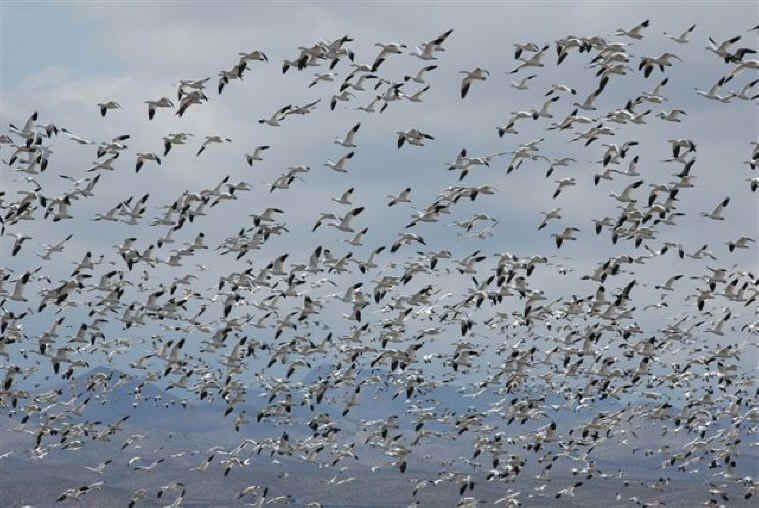
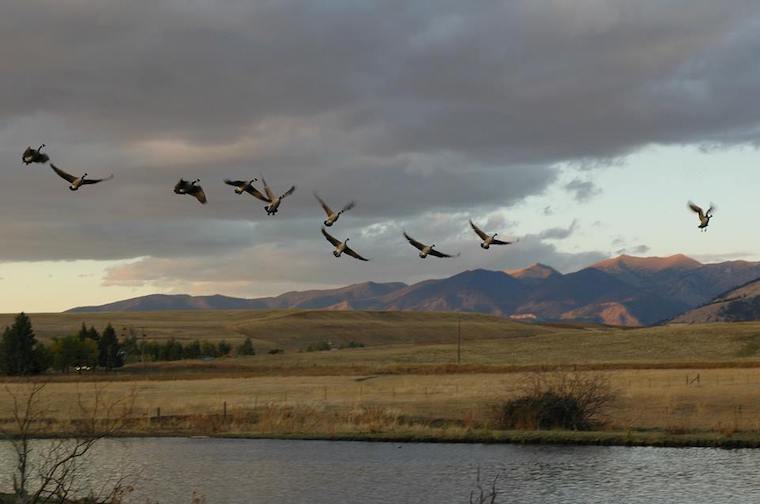
“And then the dawn was pierced by the sonorous cries of seemingly endless flocks of geese that came drifting, wraithlike, overhead. They were flying low that day. Snow geese, startling white of breast, with jet-black wing tips, beat past while flocks of piebald wavies kept station on their flanks.
An immense V of Canadas came close behind. As the rush of air through their great pinions sounded in our ears, we jumped up and fired. The sound of the shots seemed puny and was lost at once in the immensity of wind and wings.
“One goose fell, appearing gigantic in the tenuous light as it spiraled sharply down. It struck the water a hundred yards from shore, and I saw it had only been winged. It swam off into the growing storm, its neck outstretched, calling…calling…calling after the fast-disappearing flock.
“Driving home to Saskatoon that night I felt a sick repugnance for what we had done, but what was of greater import, I was experiencing a poignant but indefinable sense of loss. I felt, although I could not then have expressed it in words, as if I had glimpsed another and quite magical world—a world of oneness—and been denied entry into it through my own stupidity.
“I never hunted for sport again.”
Now that’s what I call an ethical (ex)hunter.
Portions of this article were excerpted from the book,
Exposing the Big Game: Living Targets of a Dying Sport by Jim Robertson
Jim Robertson is the President of the Committee to Abolish Sport Hunting. He can be reached at wolfcrest@hotmail.com